Here's the honest comparison. We hire silent disco kit for a living, but there are definitely situations where a traditional DJ is still the right call — and pretending otherwise does silent disco companies no favours.
Where silent disco has the edge
Venues with a noise curfew
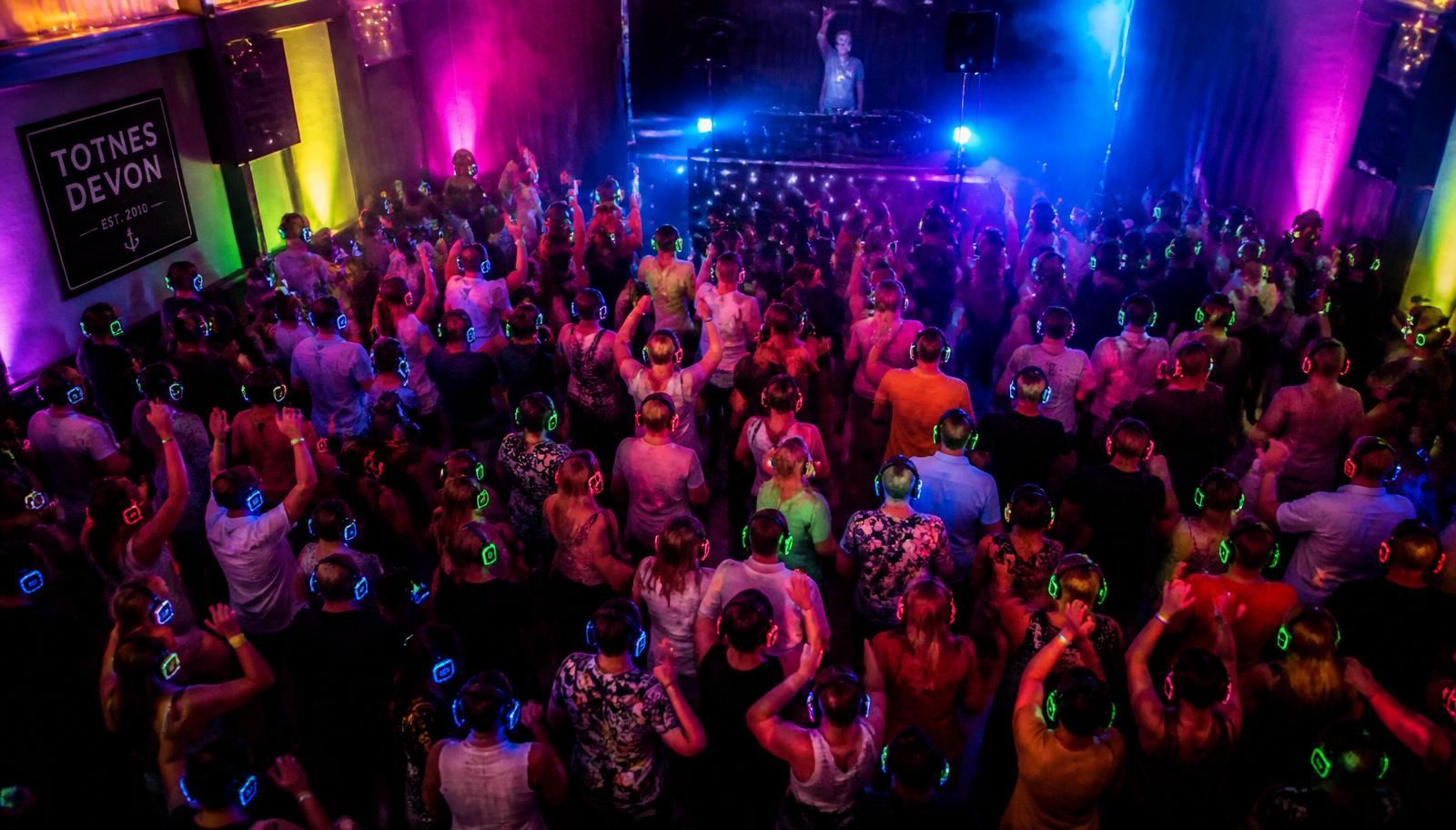
Barns, country estates, marquees, village halls and most rural Devon wedding venues run a sound curfew — often 11pm or midnight — enforced by a noise limiter that cuts a DJ's power if the room gets too loud. A silent disco has no speaker output at all, so the limiter never trips and you can carry on dancing for as long as the venue allows.
A mixed-age guest list
Every wedding faces this: the parents' generation wants Motown, the uni friends want 2010s indie, the cousins want current chart. One DJ playlist can only please one group at a time. Three channels sort it — every group gets their moment, at the same time.
Outdoor events
Gardens, beaches, courtyards and open-air marquees are usually a neighbour-relations headache with a PA rig. Silent disco takes the problem off the table entirely — the loudest sound in the garden is the laughter.
Wanting to dance past midnight
With no speaker noise escaping the room, silent discos routinely run past midnight without a single complaint. Traditional DJs usually can't.
Silent disco isn't a replacement for live music — a band or acoustic ceremony set still needs its own PA. Silent disco kit is aimed squarely at the dancefloor part of the night.
Where a traditional DJ still wins
One shared taste, played loud
If it's a 30th birthday and the whole room's after one genre, a live DJ reading the crowd in real time is genuinely great. Silent disco channels are typically pre-planned playlists — flexible, but they don't respond to the room the way a skilled DJ can.
A full-room, chest-thumping sound
Headphones sound brilliant, but they won't rattle the floor. If bass you can feel in your chest is what you're after, book a proper PA.
An MC-driven evening
Announcements, first-dance intros, birthday shout-outs — a DJ with a mic handles this effortlessly. It's doable on a silent disco (make an announcement on one channel with everyone tuned in), but it takes a bit more coordination.
Cost — the real numbers
In Devon, a professional wedding DJ typically runs £400–£800 for the evening once travel and setup are included. A silent disco from No Noise starts at £129 for 25 headphones, rising to £199 for 100 — with free delivery anywhere in the county. Even with an on-site operator added at £20/hour, the total usually comes in well under a live DJ.
The exception is when you're booking a DJ for a specific style they know inside out — Northern Soul, drum & bass, classic hip-hop. That fee is buying their expertise, not just their kit, and it's often money well spent.
Can you do both?
Absolutely — and it works brilliantly. A common setup: live band for the first hour, traditional DJ from 9pm until the venue's music curfew, then switch to silent disco for guests who want to keep dancing. You get the live-DJ atmosphere early and the freedom to push past the noise limit later.
Quick summary
- Barn/marquee wedding, mixed-age crowd, dancing past midnight → silent disco.
- Outdoor party with close neighbours → silent disco.
- Kids party (any age) → silent disco (volume-controlled).
- Nightclub-style, single-genre event, no curfew → traditional DJ.
- School disco, prom, sixth-form social → silent disco.
- Big-band-era or live-instrument feel → live band, not silent disco.
Not sure which camp you're in? Get in touch with your event details and we'll give you a straight answer — even if that means pointing you towards a DJ instead.